 The
The Every distance in this atlas rests on a chain of measurements, each rung calibrated by the one below it. The chain starts with geometry a surveyor would recognise and ends with the redshifts of galaxies billions of light-years away — and if any rung is wrong, everything above it moves.
Look up and you see a projection. A faint smudge might be a small cloud of gas a few hundred light-years away or an entire galaxy of a hundred billion stars far outside our own; brightness alone cannot tell you which, because a dim nearby thing and a brilliant distant one look identical. For most of recorded astronomy this was not a technical difficulty but a wall. Nobody knew whether the spiral "nebulae" were nearby eddies of gas inside the Milky Way or separate galaxies, and the question could not be settled by looking harder.
Breaking the wall needs a standard candle: a class of object whose true brightness you can work out from something other than how bright it appears. Compare true brightness to apparent brightness and the distance falls out of the inverse-square law. The whole ladder is the search for such objects, each visible further away than the last.
Leavitt's rung: stars that keep time
Between 1893 and 1921 Henrietta Swan Leavitt worked at the Harvard College Observatory measuring stars on photographic plates. Cataloguing variable stars in the Magellanic Clouds, she noticed something that turned out to matter enormously: among the class now called Cepheids, the brighter stars took longer to complete their cycle of pulsation. In 1912 she published the relation from 25 Cepheids in the Small Magellanic Cloud.
Because those stars all sat at effectively the same distance from us, their apparent brightnesses could be compared directly — the Cloud's depth is small next to how far away it is. That single fact converted a period, which anyone with a telescope and patience can measure, into a true luminosity. Leavitt had found the first rung that reached beyond our own galaxy, and she was not permitted to follow it up; Harvard's women computers were hired to measure, not to interpret.



Slipher's puzzle: everything is leaving
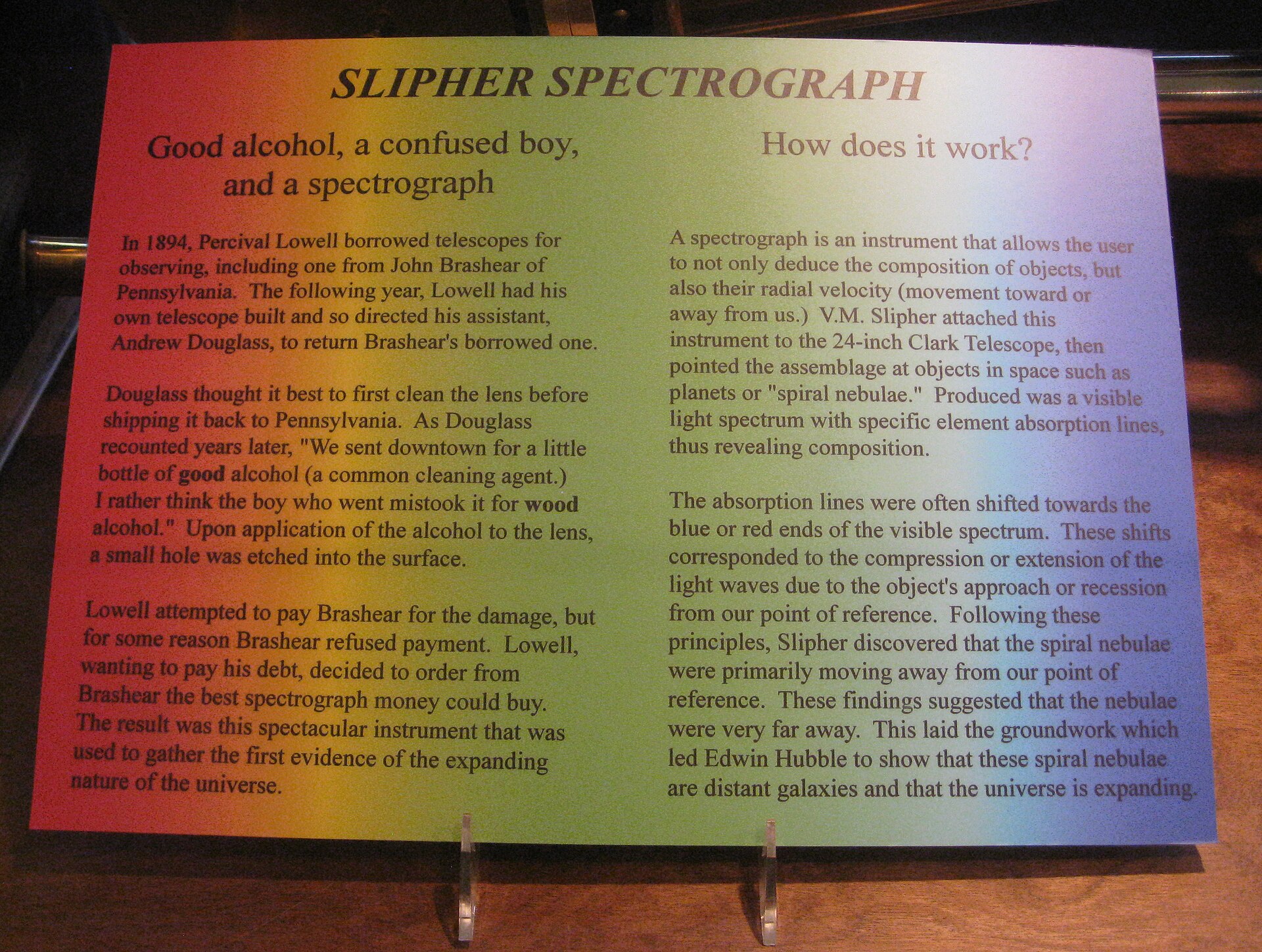
While Leavitt was measuring brightness, Vesto Slipher at Lowell Observatory was measuring motion. Spectra of the spiral nebulae taken from 1912 onward showed their light shifted toward the red, and by 1917 he had two dozen of them, nearly all receding, at speeds of hundreds of kilometres per second — far faster than any star in the Milky Way. Slipher had the velocities a decade before anyone could pair them with distances, and without distances they were a curiosity rather than a cosmology.
Hubble joins the two halves
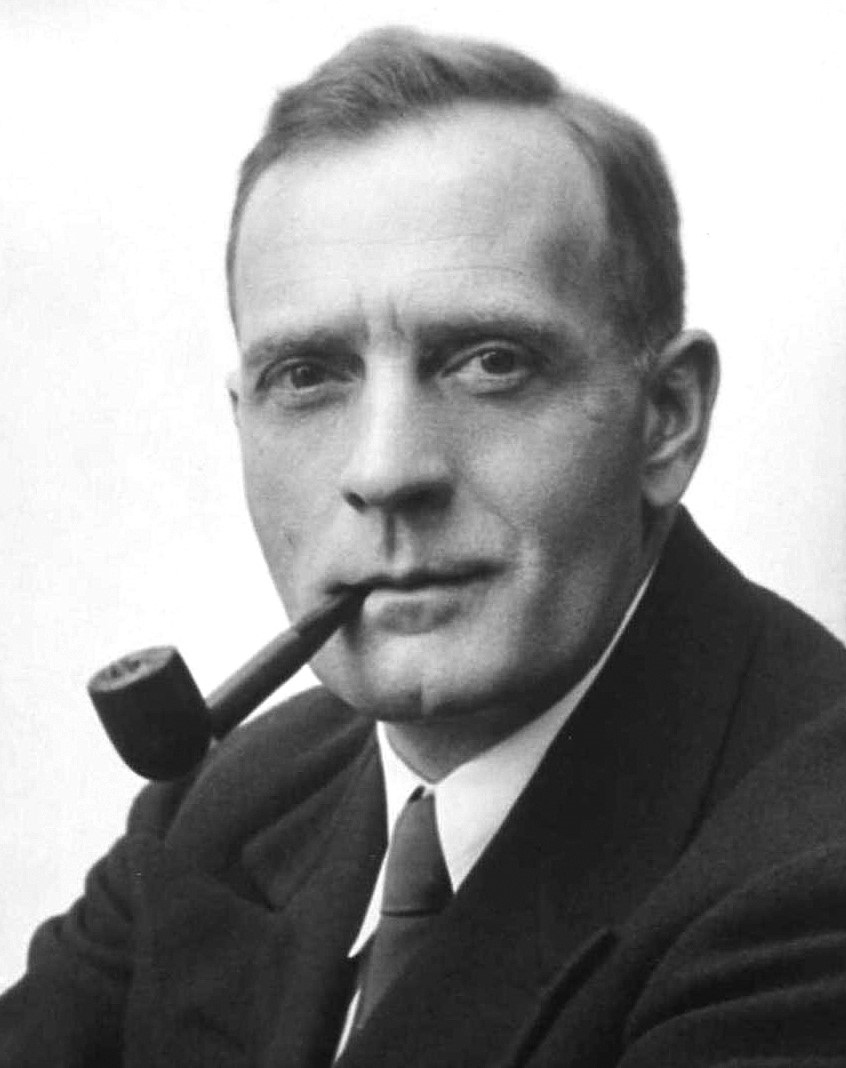
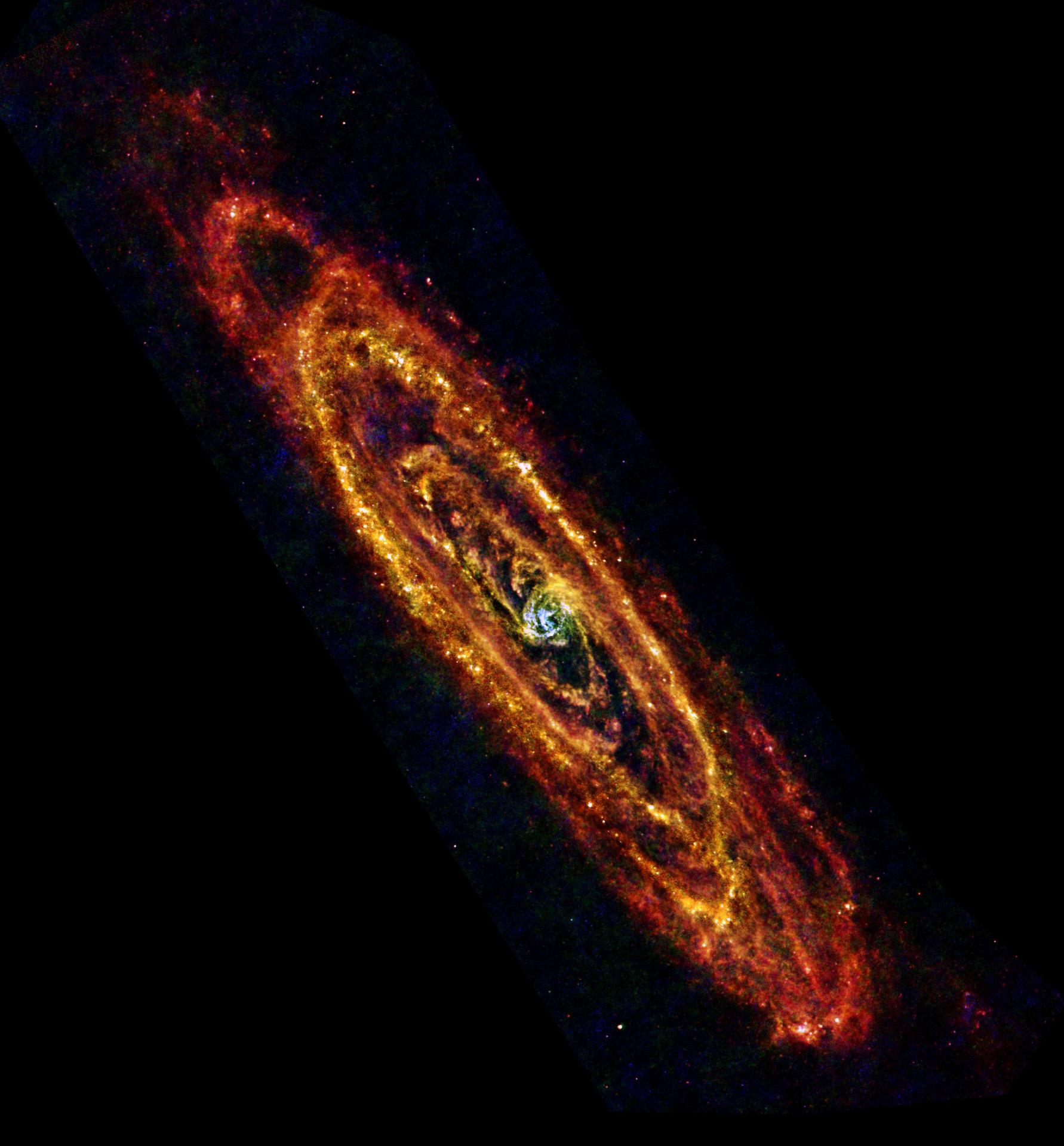
In October 1923 Edwin Hubble found a Cepheid on a photographic plate of the Andromeda "nebula" taken with the 100-inch telescope at Mount Wilson. Leavitt's relation turned its period into a luminosity, its faintness into a distance, and the answer put Andromeda far outside the Milky Way. The spiral nebulae were galaxies, the universe was enormously larger than the Milky Way, and the question that had stood for a century closed in a single plate.
Six years later Hubble combined his distances with Slipher's velocities and found them proportional: the further away a galaxy, the faster it recedes. His slope came out near 500 km/s/Mpc, roughly seven times today's value, and the error took decades to unpick. Baade showed in 1952 that the Cepheid calibration had conflated two different classes of variable star, worth about a factor of two; Sandage found in 1958 that what Hubble had taken for the brightest individual stars in distant spirals were often glowing clouds of gas, far brighter. The relationship was right even though the number was badly wrong, which is a useful thing to remember about new measurements.
.JPG)
The ladder as it stands
Modern distances are still a chain, and each link is calibrated by the one beneath it. Parallax — the apparent shift of a nearby star as Earth orbits the Sun — is pure geometry and needs no assumptions, and Gaia has now measured it for well over a billion stars. Parallax calibrates Cepheids and the tip of the red giant branch; those calibrate galaxy-wide relations such as Tully–Fisher; and those calibrate type Ia supernovae, which are bright enough to be seen halfway across the observable universe. Beyond that, redshift itself becomes the distance indicator.
The rung that reaches furthest: type Ia supernovae
Cepheids are bright, but not bright enough: past roughly 100 million light-years even Hubble cannot pick individual ones out of the glare of their host galaxy. The top rung is a different object entirely. A type Ia supernova is a white dwarf that has accreted matter from a companion until it detonates, and because the explosion is triggered at a characteristic mass, they all release close to the same energy — briefly outshining the entire galaxy around them.
They are not perfectly standard, but they are standardisable: the brighter ones fade more slowly, and correcting for that tightens the scatter to a few per cent. One supernova can be seen billions of light-years away, which is what makes the whole chain worth building — and it is why the 1998 measurement that found the expansion accelerating was made with them.
The chain's weakness is obvious once stated: an error low down propagates all the way up, multiplied. Hubble's factor-of-seven error was exactly this — a mis-calibrated bottom rung, faithfully carried to the top.
Rebuilding Hubble's diagram from data
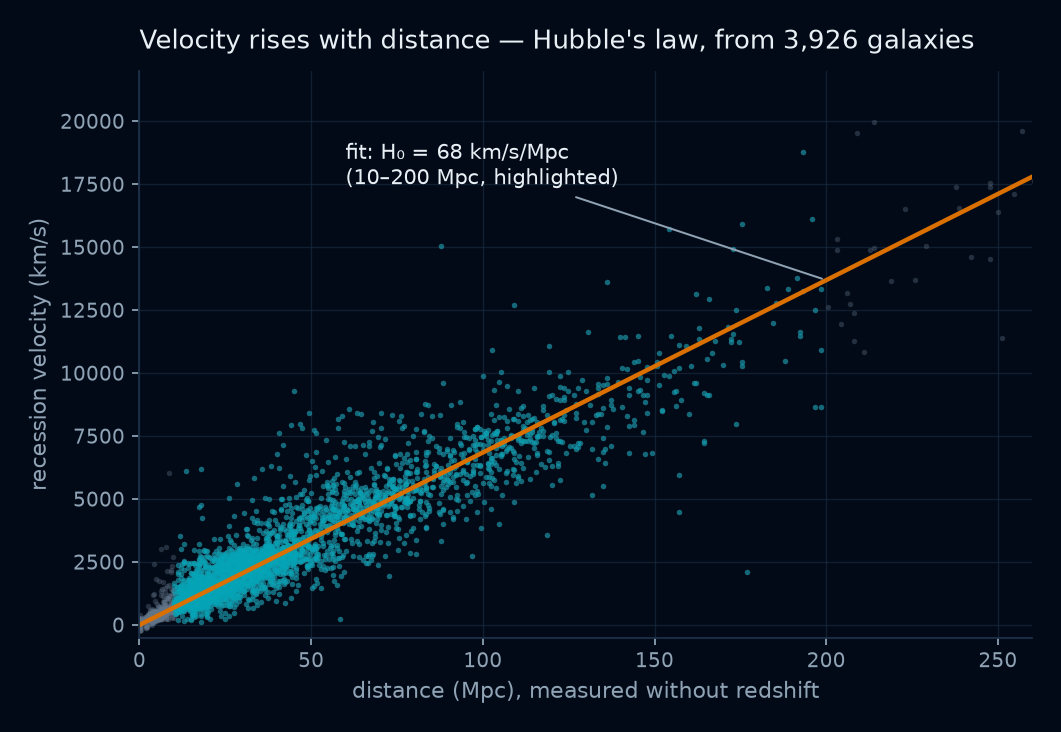
The relation is easy to state and easy to fake, because most catalogued "distances" are themselves computed from redshift — plot those against redshift and you get a perfect line that demonstrates nothing but arithmetic. To make the argument honestly you need distances measured some other way, and HyperLEDA records them for 3,926 galaxies, from Cepheids, the red giant branch, Tully–Fisher and supernovae.
Plotting those against velocity reproduces Hubble's result and puts a number on it. Fitting the 3,345 galaxies between 10 and 200 Mpc gives H₀ = 68 km/s/Mpc — inside the range of published values, from a few thousand rows of a public catalogue and a straight line through the origin.
Where it goes wrong, and why that is interesting
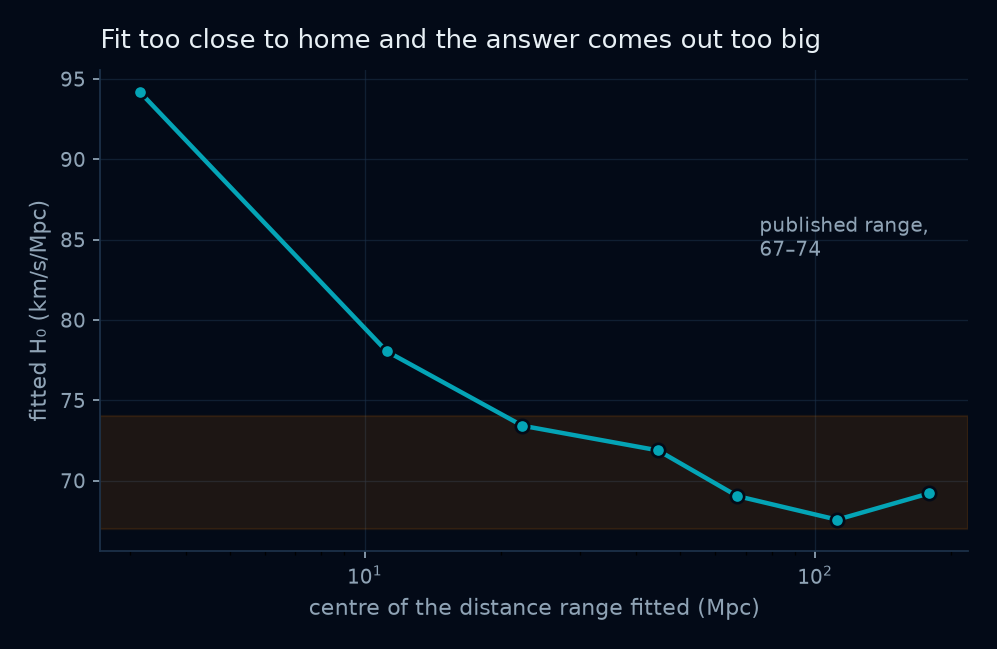
Fit the same relation using only nearby galaxies and the answer comes out badly too large — about 94 km/s/Mpc inside 10 Mpc. Nothing is wrong with the data. Galaxies have their own motions, pulled around by the mass near them at several hundred kilometres per second, and close to home that peculiar motion is a large fraction of the total. Only at greater distances does the expansion dominate the noise.
This is why the same measurement can be made repeatedly and get different answers depending on where you look, and it is a good illustration of a general rule: the hard part of a measurement is usually not the instrument but knowing which of your objects the model actually describes.
The tension at the top of the ladder
Two ways of measuring H₀ now disagree by more than their stated errors. The ladder route — parallax to Cepheids to supernovae — gives about 73 km/s/Mpc. Inferring it instead from the cosmic microwave background, using the standard cosmological model to project the early universe forward, gives about 67.4. Both teams have spent years hunting for the mistake and neither has found it.
The disagreement is roughly 8%, which sounds small and is not: it is either a subtle systematic error in one of the two methods, or a sign that the standard model of cosmology is missing something between the early universe and now. Our own fit lands near the low end, but with a heterogeneous catalogue and a one-parameter fit it should not be read as a vote — it is a demonstration of the method, not a measurement that competes.
Next: what those distances reveal once you plot millions of galaxies at once — or go straight to the map.