 The
The A galaxy is a gravitationally bound system of stars, gas, dust and dark matter — anything from a dwarf of a few million stars to a giant elliptical of several trillion. They are the units this atlas is built from, and their shapes are not decoration: a galaxy's form records what has happened to it.
Two families, and what separates them
Most galaxies fall into two broad kinds. Spirals are flat, rotating discs with arms picked out by young blue stars and the gas they formed from; the Milky Way is one. Ellipticals are smooth three-dimensional swarms whose stars orbit in every direction at once, with little cold gas and little recent star formation. The difference is not cosmetic — it is the difference between a system held up by rotation and one held up by the random motions of its stars.
That distinction turns out to track history. Discs are fragile: a major merger destroys the ordered rotation and leaves a pressure-supported swarm. So ellipticals are, broadly, what you get after violence, which is why they dominate the crowded centres of clusters while spirals prefer quieter neighbourhoods.
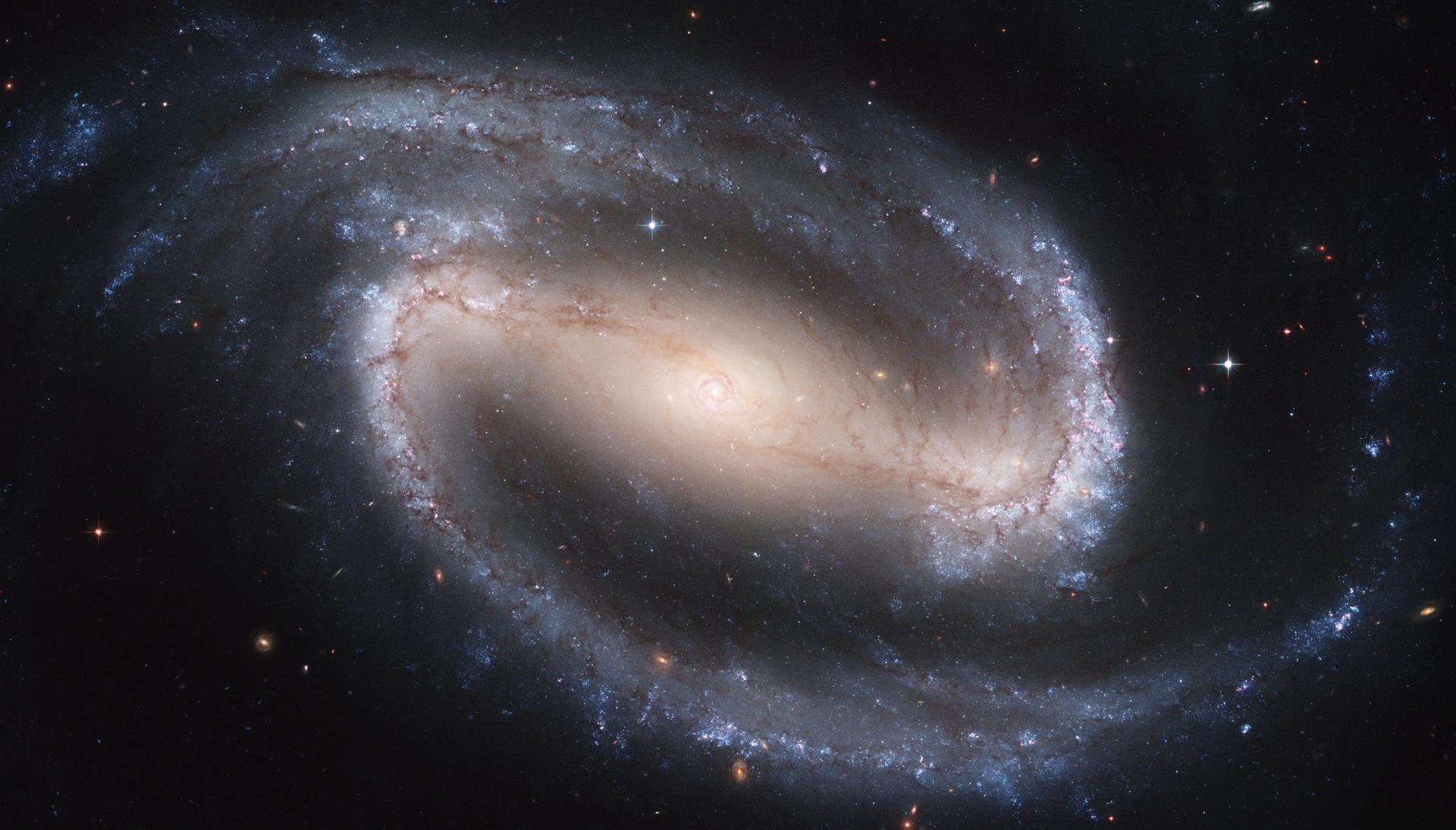
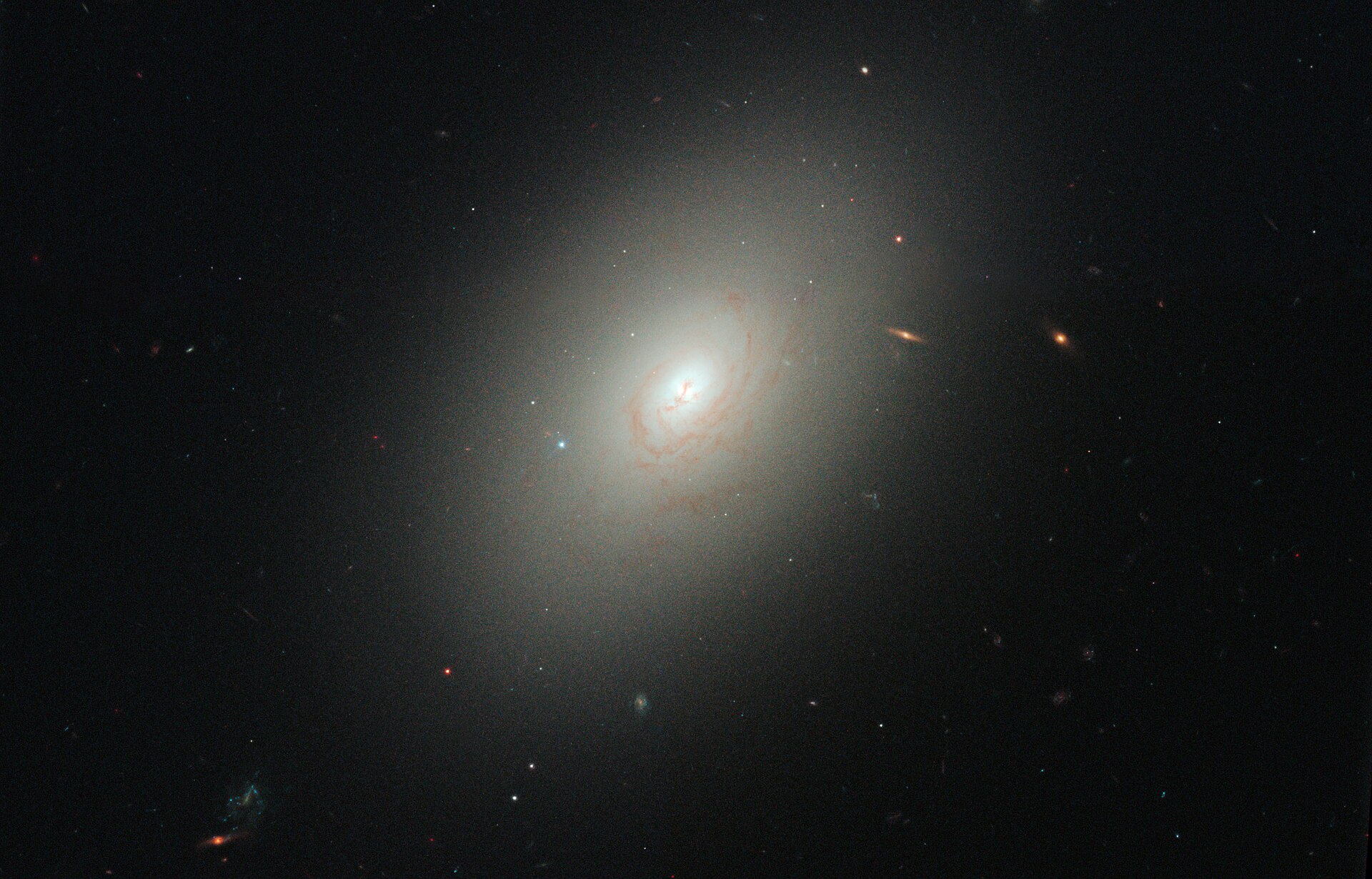

Put the two side by side and the difference is structural rather than decorative. The spiral has a plane; the elliptical does not. Everything in the disc goes round the same way, which is why a disc can be drawn as a picture of its own rotation — and why it is so easily destroyed.
The Hubble sequence
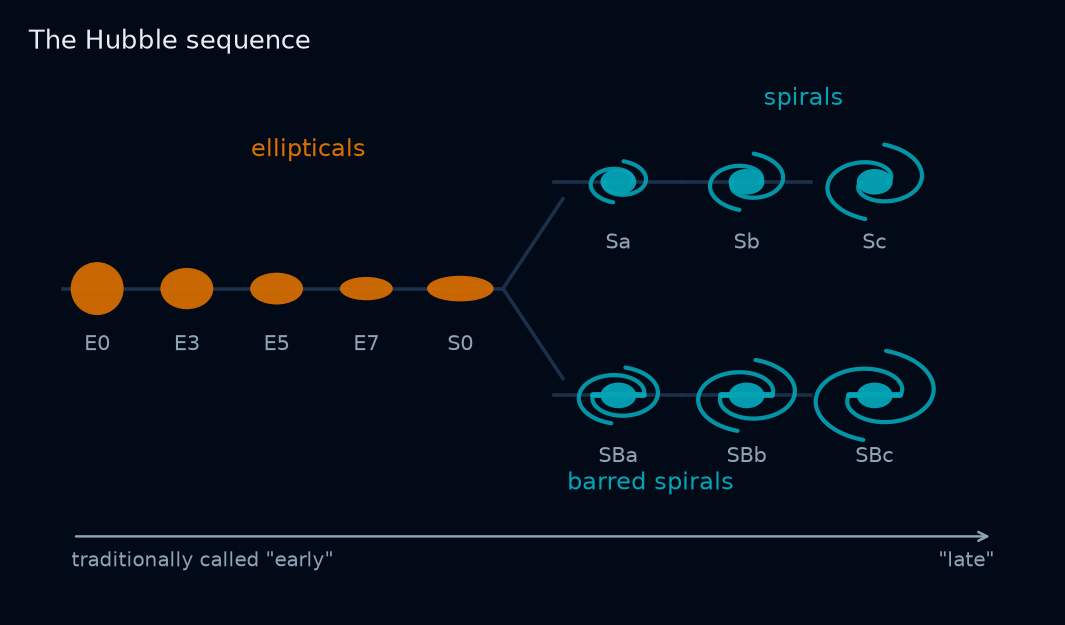
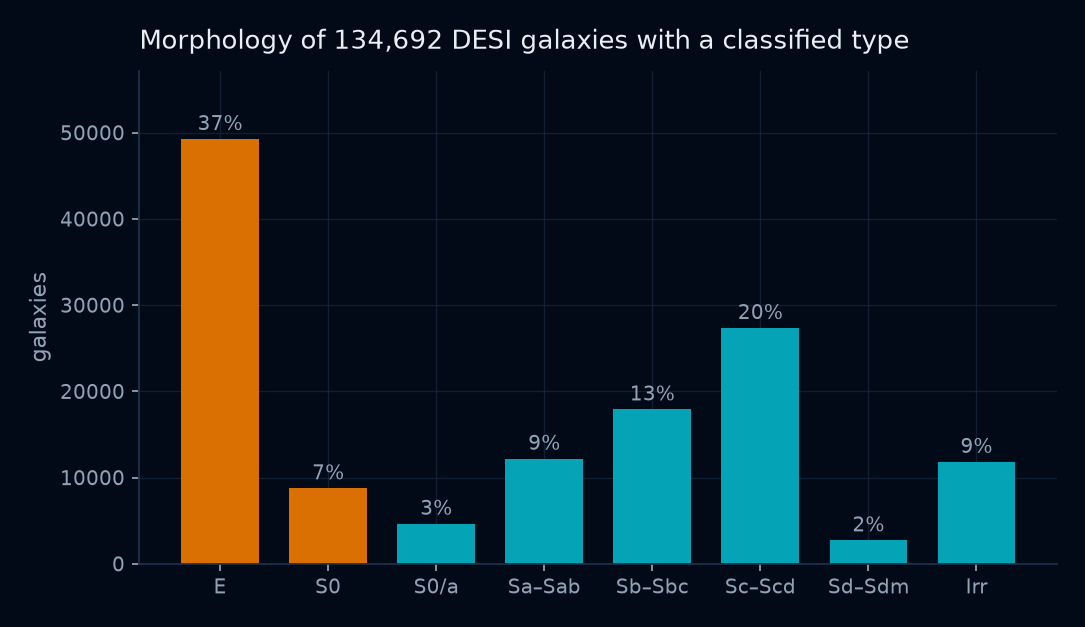
Hubble's 1936 classification arranged galaxies from ellipticals through lenticulars to spirals of increasingly open arms, drawn as a tuning fork. The scheme is still the working vocabulary of the field, and the numeric T-type used in modern catalogues runs along the same axis: about −5 for an elliptical, −3 to −1 for a lenticular, 0 at the S0/a transition, +5 for a middling spiral, +10 for an irregular.
Ellipticals are still routinely called early-type galaxies and spirals late-type, and the words mislead. They came from reading the diagram left to right as a life story, with galaxies starting smooth and developing arms. Nothing of the sort happens. Where evolution does run between the two, it runs the other way: mergers destroy discs and leave pressure-supported swarms, so a spiral can become an elliptical but not the reverse. The terms survive because a century of literature is written in them, and they now mean nothing more than "left end" and "right end" of this diagram.
Mergers are the engine
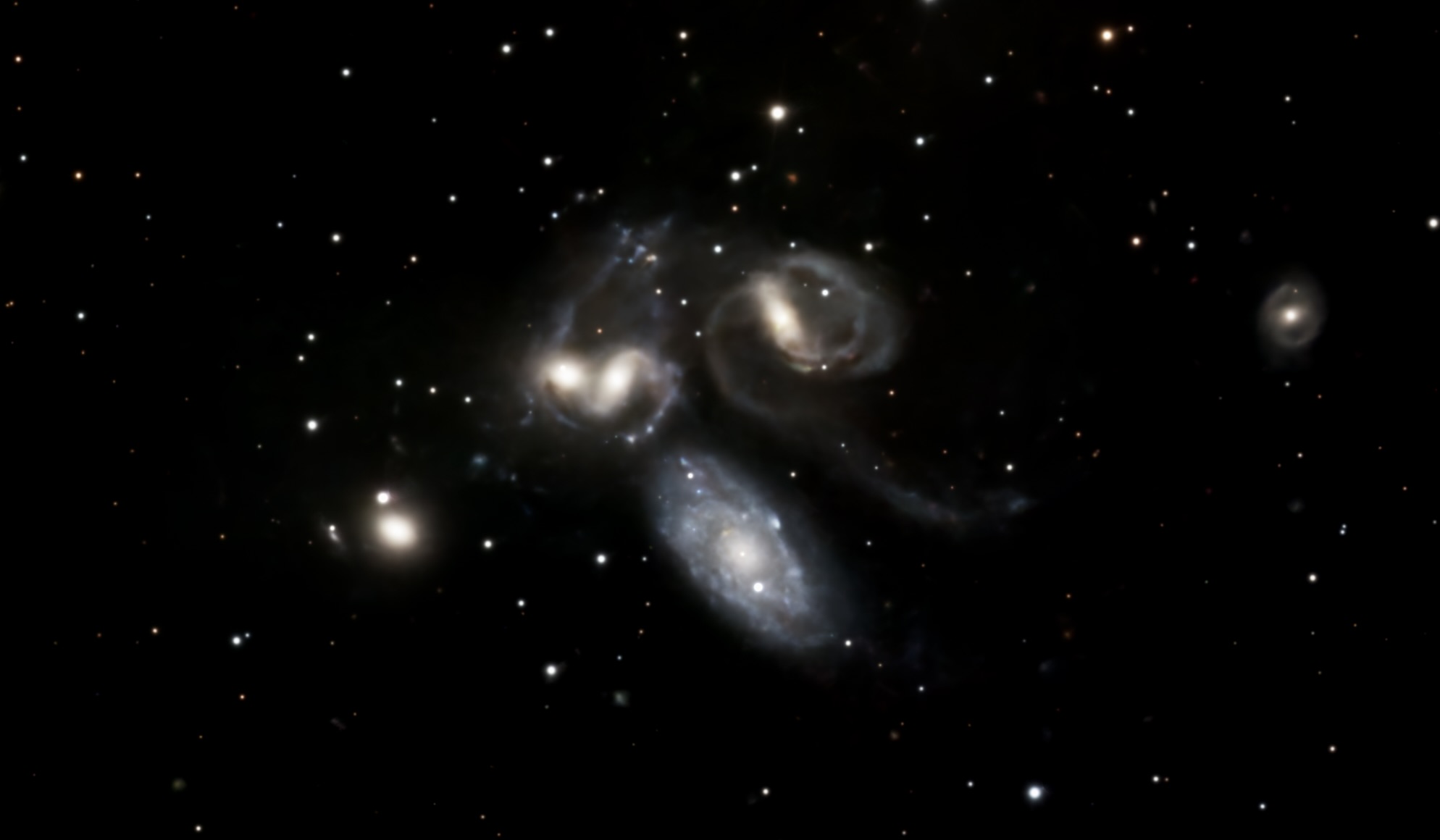
Galaxies are not isolated. They orbit in groups and clusters, pass close enough to raise tides in one another, and sometimes merge outright. Tidal forces draw out the long bridges and tails that mark interacting pairs — structures made not of anything new but of stars flung from the discs onto wildly elongated orbits.
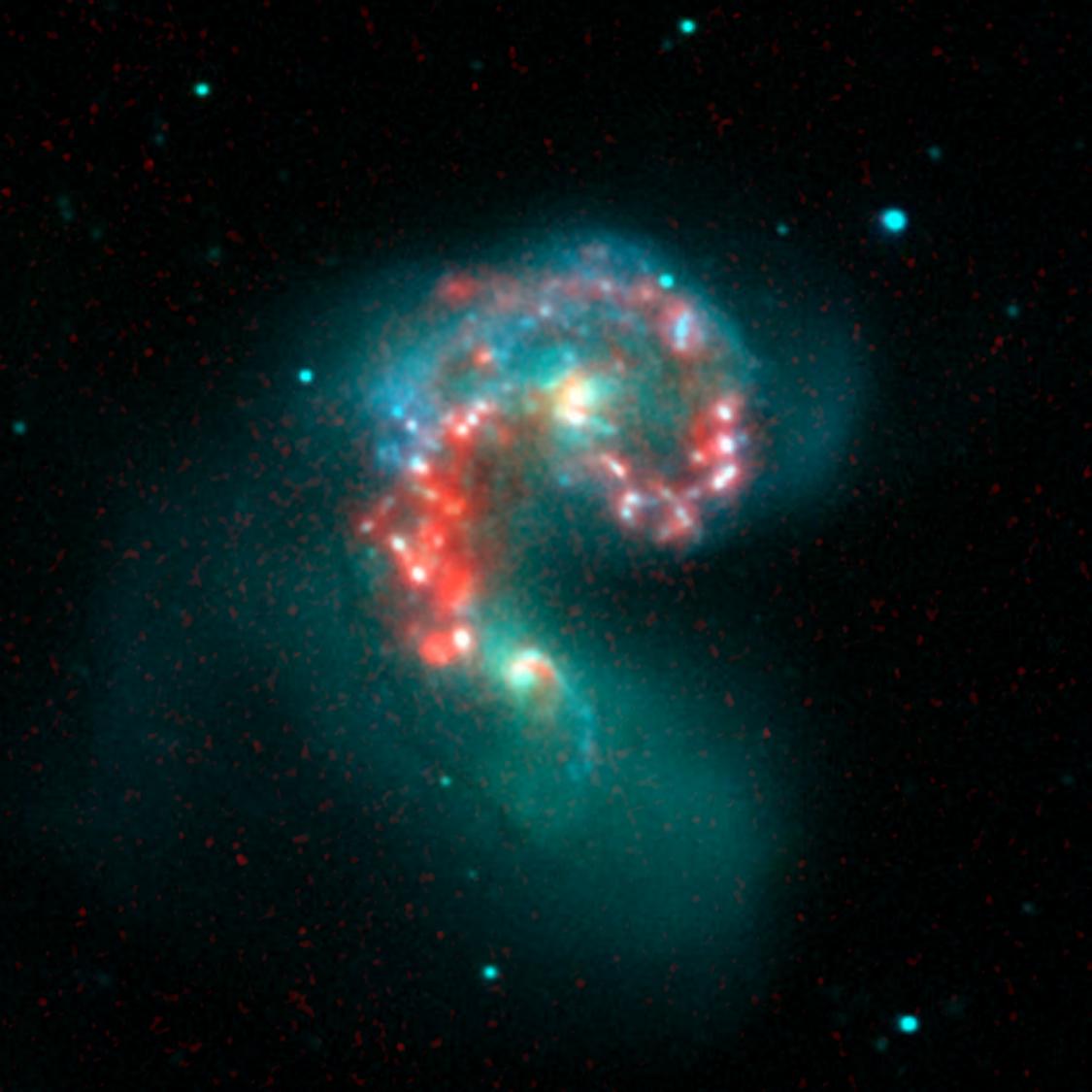
The physics is simple enough to simulate in a browser: two point-like cores on a Keplerian orbit and a swarm of massless test particles feeling their pull. That is enough to reproduce the Antennae, the Mice and the ring galaxies, which is a strong hint that gravity alone shapes what we see.
The Milky Way and Andromeda are on such a course now, closing at about 110 km/s, with a first pass expected in roughly four billion years. The Sun will almost certainly not collide with anything: galaxies are overwhelmingly empty space, and it is the orbits, not the stars, that get wrecked.
Try it yourself — the simulator on this site runs that encounter, and half a dozen real ones, live.
Where the light comes from
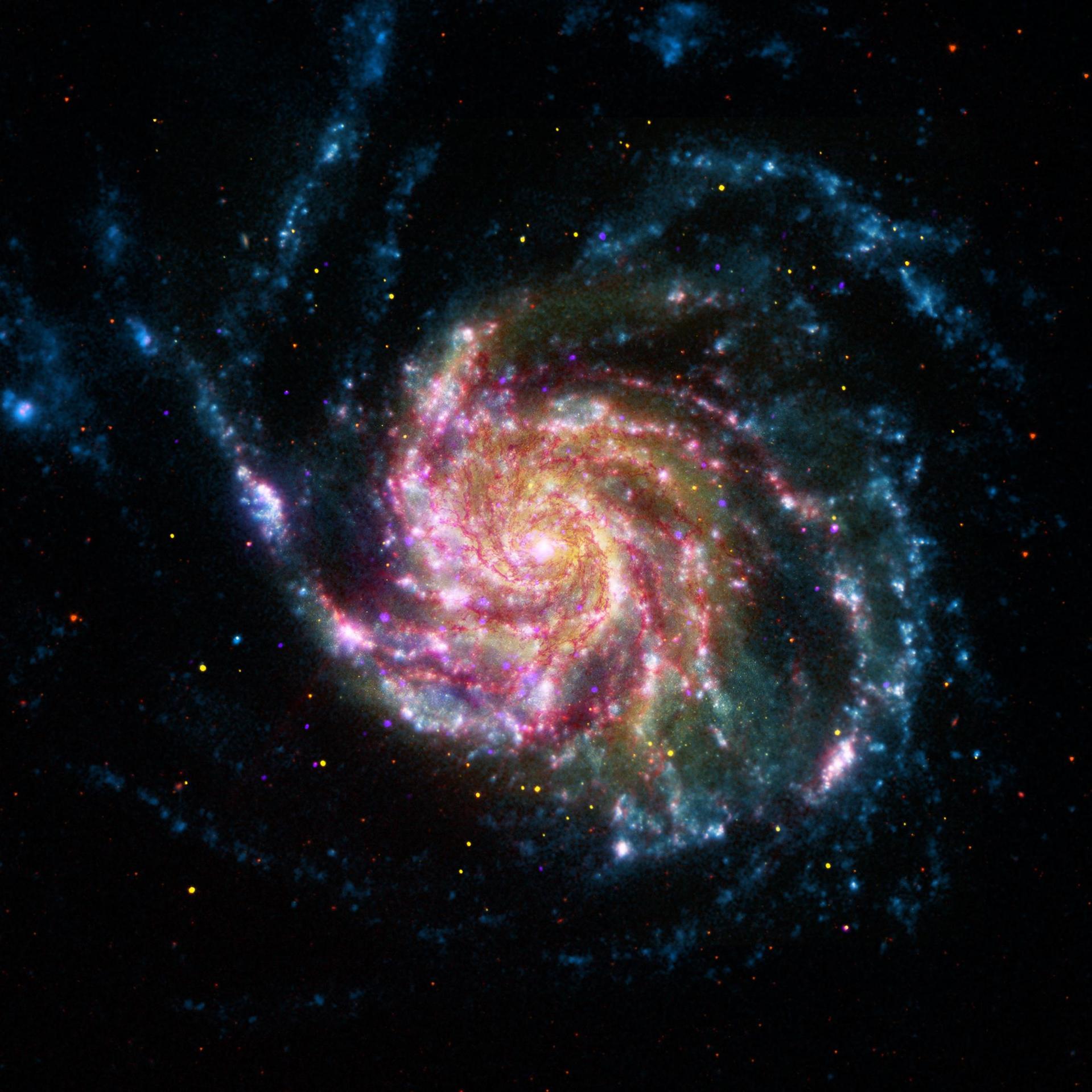
Almost every image on this page is a false-colour composite, and it is worth being clear about what that means. Telescopes record intensity in chosen wavelength bands, many of them outside the range human eyes respond to; making a picture means assigning those bands to red, green and blue. The choice is made to reveal structure, not to reproduce an appearance, and a galaxy in infrared light can look nothing like the same galaxy in visible light.
This is not a fudge, but it does mean "what it really looks like" is a question without a single answer. Each caption here says which light the image was made in.
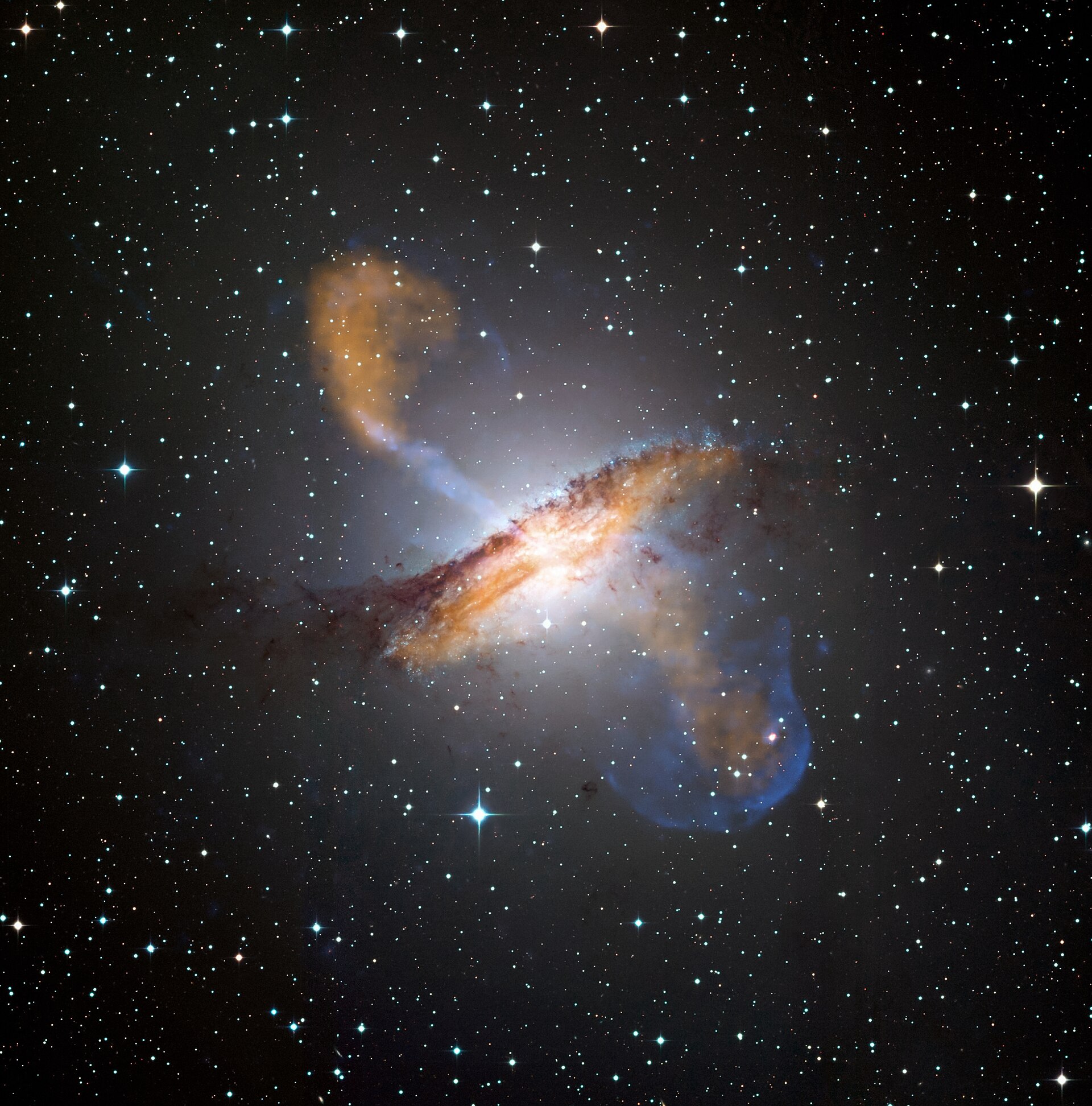
Next: how we measure the distance to any of them, or what they build when you plot millions at once.