 The
The A century ago the universe was assumed to be static, eternal and roughly the size of the Milky Way. Every part of that turned out to be wrong, and in each case the change was forced by a measurement nobody was looking to make. This page follows that sequence.
1917–1929: the universe will not sit still
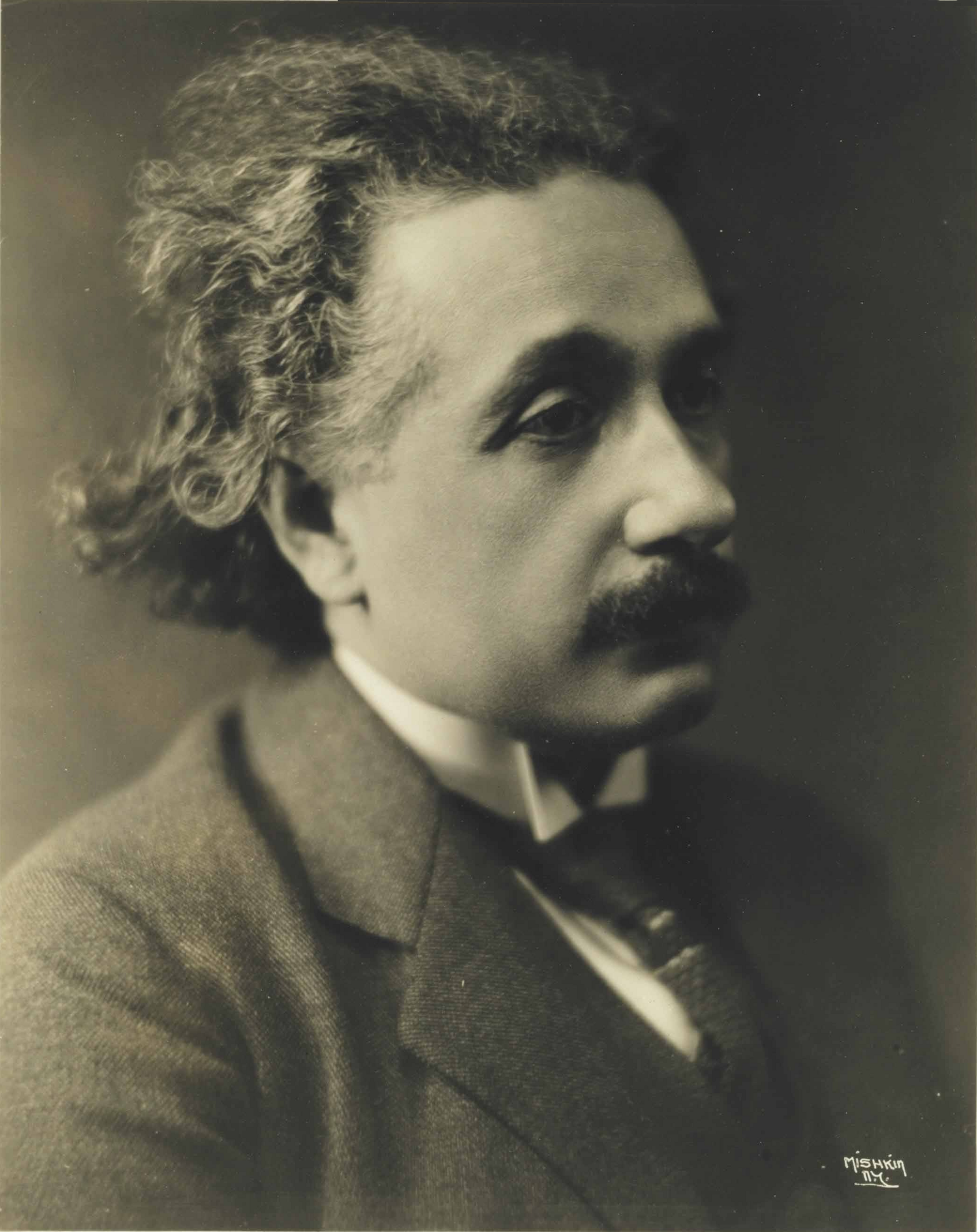
When Einstein applied general relativity to the universe as a whole in 1917, the equations refused to give him a static solution — gravity pulled everything together. He added a term, the cosmological constant Λ, tuned precisely to hold the universe still. It was an unstable balance, and it was answering a question nobody had checked: whether the universe is static at all.
Others took the equations at face value. Alexander Friedmann in 1922 and Georges Lemaître in 1927 independently found expanding solutions, and Lemaître went further, deriving a proportionality between a galaxy's distance and its recession velocity and estimating the constant from Slipher's velocities and Hubble's distances — two years before Hubble's own paper. Lemaître published in French in a Belgian journal, and the result went largely unread until Hubble's 1929 measurement made it impossible to ignore.


.jpg)
1931–1965: an origin, and its leftover heat
Run expansion backwards and the universe was denser and hotter in the past; run it far enough back and there is a beginning. Lemaître proposed exactly that in 1931 — a "primeval atom" from which everything unpacked. The idea was resisted for decades, partly on the reasonable grounds that a theory positing a first moment is hard to test, and partly because the steady-state alternative was elegant. Fred Hoyle, its foremost advocate, gave the rival theory the name "Big Bang" in a 1949 broadcast.
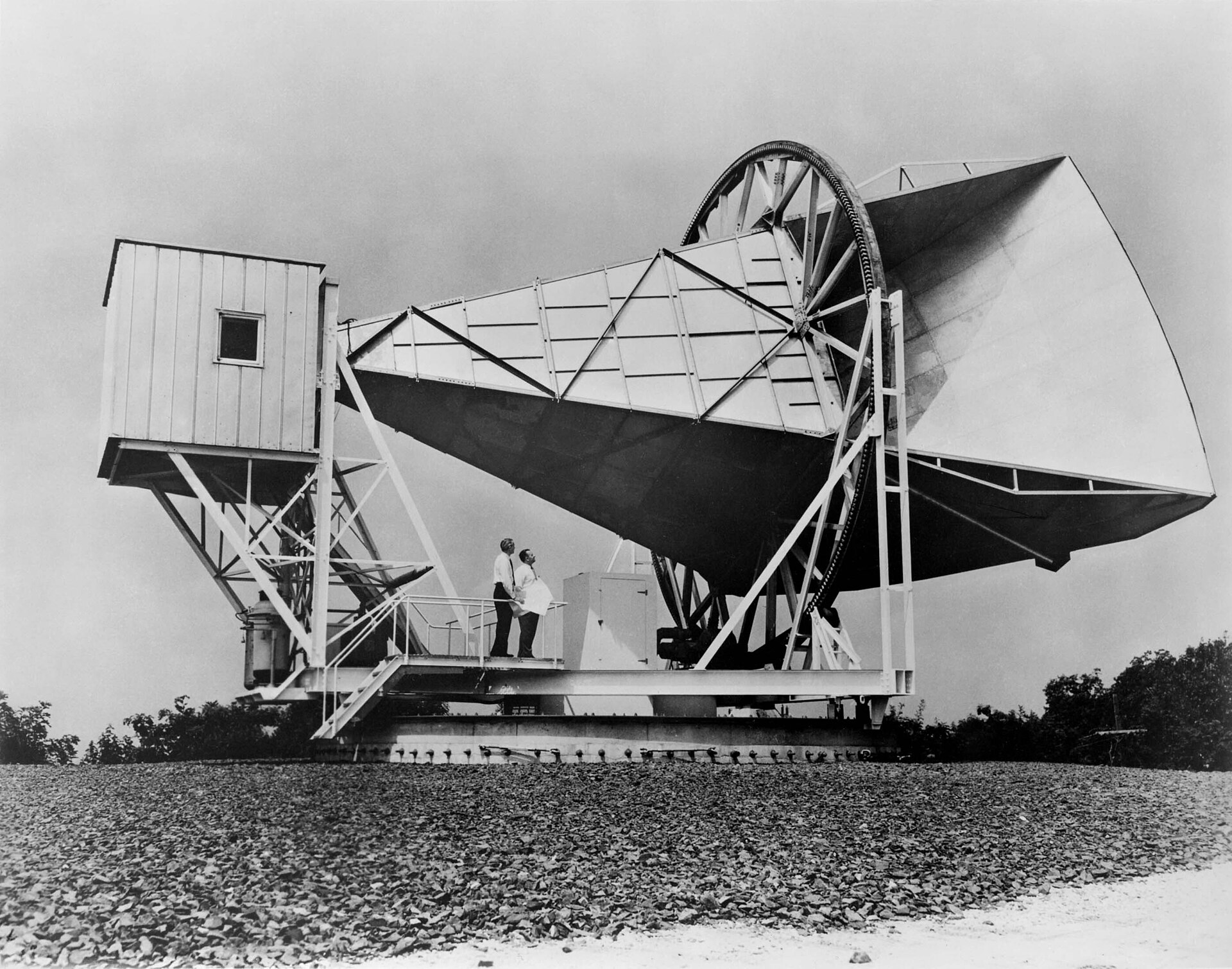
What settled it was a prediction. If the early universe was hot and dense, it was also opaque, and the moment it cooled enough to become transparent the light would have escaped — still travelling, stretched by expansion into microwaves. Alpher and Herman predicted such a background in 1948. In 1964 Penzias and Wilson, working on a radio antenna at Bell Labs, could not get rid of a faint hiss coming equally from all directions; a team at Princeton was already building an instrument to look for exactly that signal.
The cosmic microwave background is the single most informative measurement in cosmology. Its temperature is 2.725 K, and it is smooth to about one part in 100,000 — those tiny fluctuations are the density ripples that everything on this site grew from.

1933–1980: most of the matter is missing
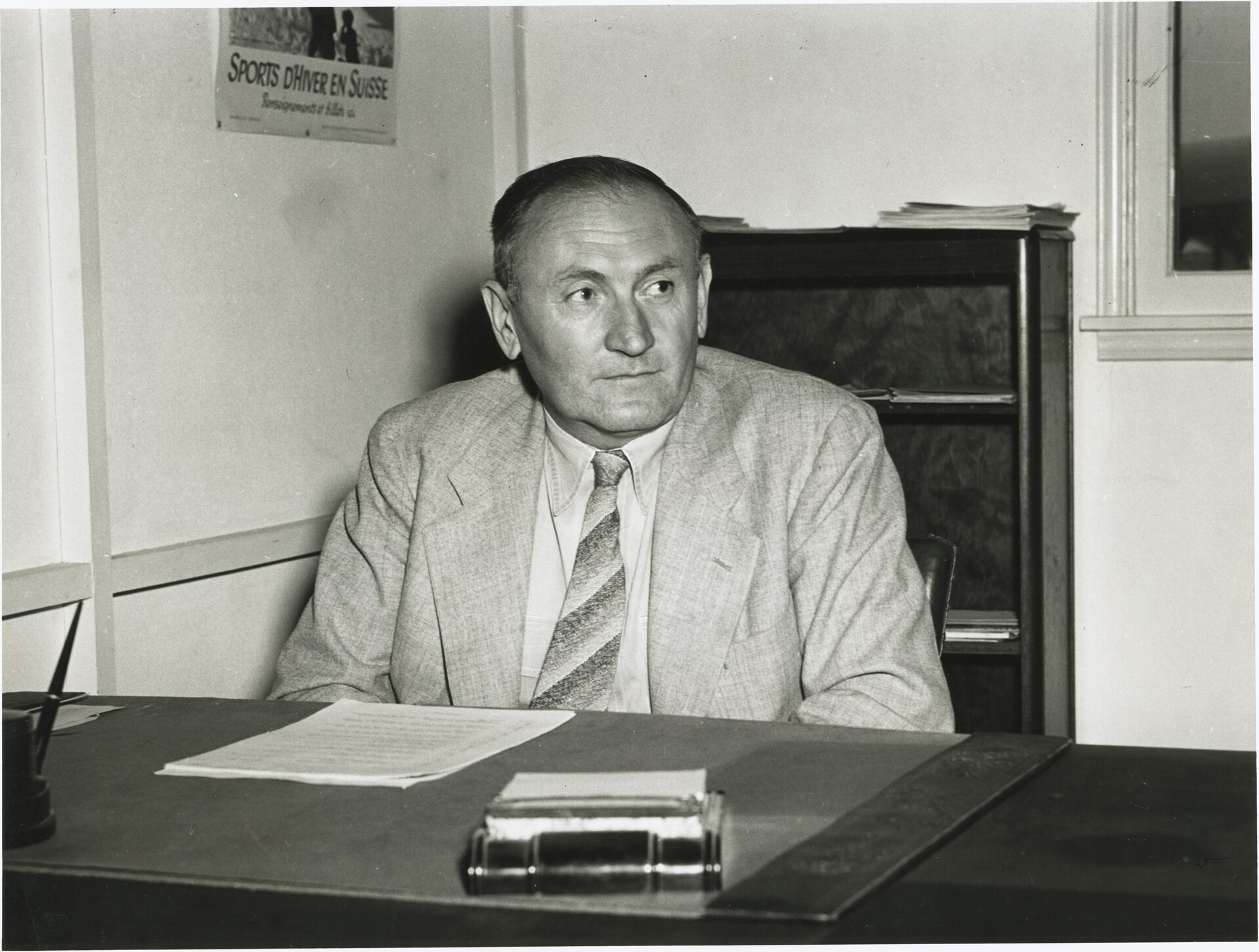
Fritz Zwicky measured the velocities of galaxies in the Coma cluster in 1933 and found them far too fast: the cluster's visible mass could not hold it together, and it should have flown apart long ago. He attributed the difference to dunkle Materie — the phrase was already in circulation, but his was the first strong dynamical evidence for it. The result was largely set aside for forty years.
It became unavoidable when Vera Rubin and Kent Ford measured how fast stars orbit within individual spiral galaxies through the 1970s. In a galaxy whose mass followed its light, orbital speeds should fall off beyond the bright central region, the way planets slow with distance from the Sun. They do not — the curves stay flat far out, which means mass keeps accumulating where there is no light. Every spiral they looked at behaved the same way.
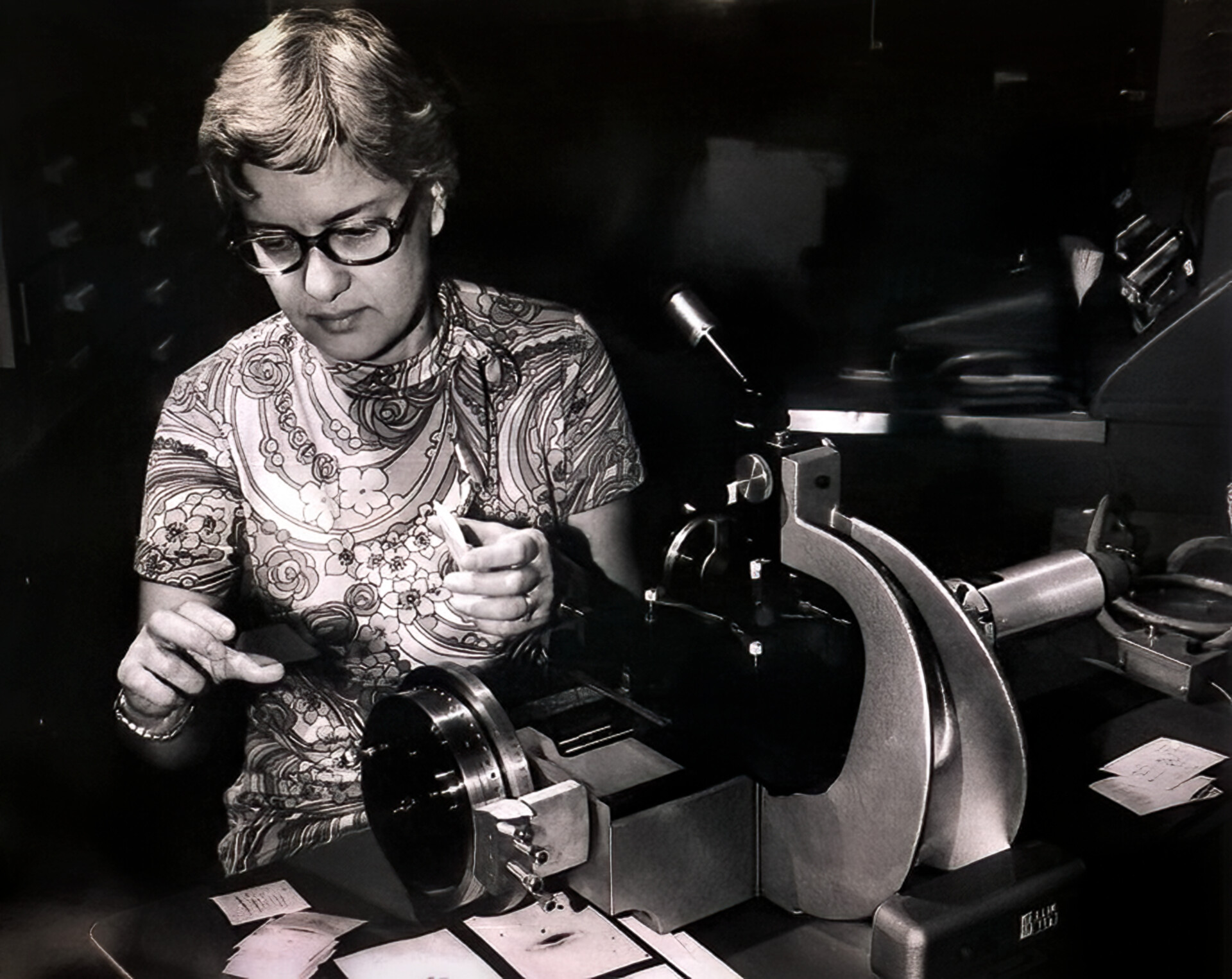

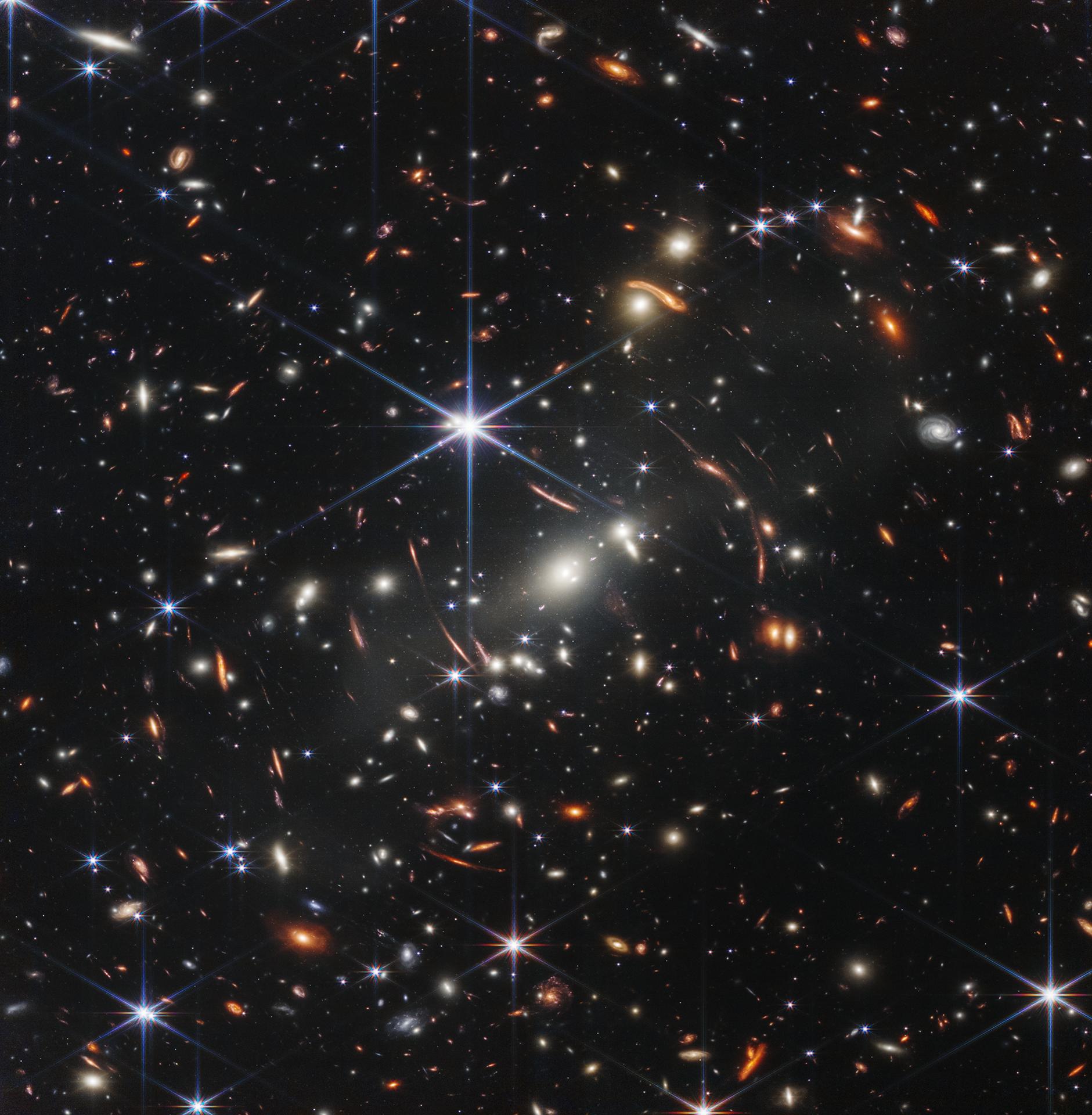
Dark matter is now supported by several independent lines of evidence that did not have to agree and do: rotation curves, the motions of galaxies in clusters, gravitational lensing, the pattern of fluctuations in the microwave background, and the fact that ordinary matter alone cannot build the cosmic web in the time available. What it actually is remains unknown. Decades of direct-detection experiments have found nothing.
1981: a fix for two awkward coincidences
The Big Bang model left two things unexplained. The microwave background has the same temperature in opposite directions of the sky, yet those regions were never in contact and could not have equalised. And the universe's geometry is flat to a precision that requires implausibly exact initial conditions. Alan Guth's inflation, published in 1981, proposed that the very early universe underwent a brief episode of enormous expansion, which resolves both by placing the whole observable universe inside one formerly tiny, causally connected patch.
Inflation also predicts something checkable: the fluctuations it stretches should have a particular statistical character, nearly the same at every scale. That is what the microwave background shows, which is the main reason the idea is taken seriously despite the mechanism behind it being unidentified.
1998: the expansion is speeding up
Two teams set out to measure how fast the expansion was slowing, using type Ia supernovae as standard candles at large distances. Gravity should decelerate expansion; the question was by how much, and whether the universe would eventually recollapse. Both teams found distant supernovae fainter than expected — meaning further away than a decelerating universe allows. The expansion is accelerating.
Whatever drives it was named dark energy, and the simplest description of it is a cosmological constant: the term Einstein had inserted for the wrong reason and then dropped. On current measurements it makes up about 68% of the universe's energy content, dark matter about 27%, and everything the periodic table describes — every star, planet, galaxy and person — about 5%.
What our own catalog shows
The theory makes a testable claim about the map on this site: structure grew by gravity from tiny initial fluctuations, so galaxies should be clustered in a particular, measurable way. The standard measure is the two-point correlation function ξ — the excess probability, over random, of finding two galaxies a given distance apart.
Measuring it needs a comparison catalogue with the same survey footprint and the same reach but no real structure. Ours is built by keeping each galaxy's direction on the sky and giving it another galaxy's distance, which destroys three-dimensional clustering while preserving everything about the survey. The result across 160,000 galaxies is a clean power law: close pairs are about seven times more common than chance, and the excess dies away by roughly 70 Mpc.
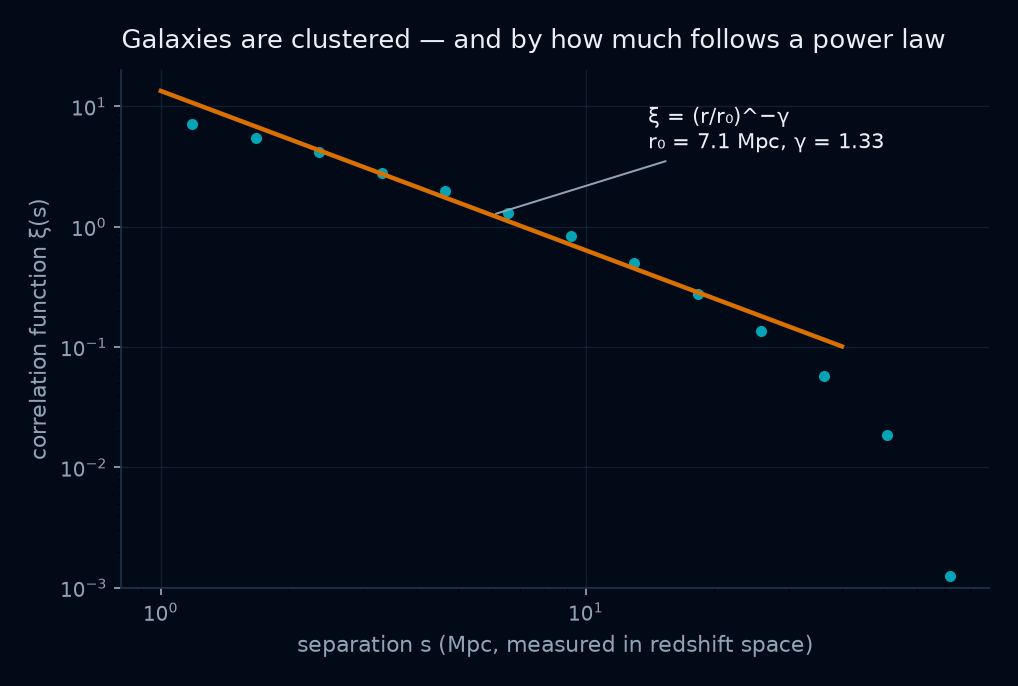
That power law is not an arbitrary fit. Its amplitude and shape are what a universe of cold dark matter, evolving under gravity from the fluctuations seen in the microwave background, is expected to produce — and measuring it precisely across cosmic time is a large part of what DESI was built to do.
What is still open
Three problems are live. The identity of dark matter is unknown, with the best-motivated candidates increasingly constrained by experiments that keep not finding them. The nature of dark energy is unknown, and whether it is truly constant is now being tested — DESI's own recent results hint that it may not be, which if confirmed would be the largest change to the model in twenty-five years. And the two ways of measuring the expansion rate disagree by more than their errors.
None of that undermines the picture on this site. The cosmic web is there in the data whatever dark matter turns out to be. But it is worth knowing, looking at the map, that the framework which explains it rests on two components nobody has identified.